
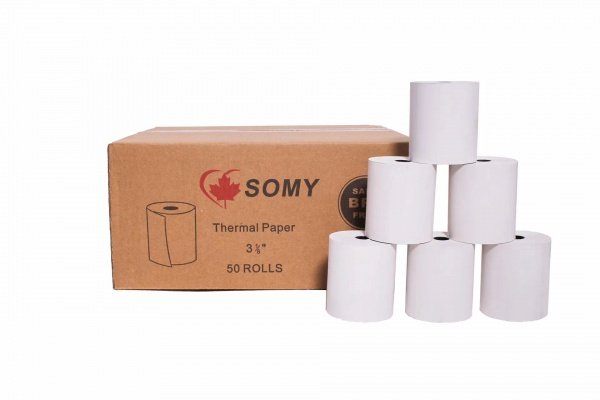
Three numbers, one working roll
A thermal roll looks simple — a white roll of paper — but whether it works in your printer comes down to three numbers, and getting any one of them wrong means the roll never feeds, or feeds badly, or runs out at the worst moment.
The three numbers are width, length, and core. They are printed on the box, and they are the whole specification. Everything else is detail.
Width: it has to match the printer
Width is the first number and the least forgiving. A thermal printer takes one width, and a roll that is too wide will not fit at all. A roll that is too narrow will feed, but the print will be off-centre and the paper can wander, which causes jams and misprints.
The two widths you will see most often in a restaurant or shop are 2-1/4″ and 3-1/8″. The smaller one is common on compact POS terminals and kitchen printers; the larger one is common on full-size receipt printers and high-volume setups. Before you order, check the printer — the width it takes is usually printed on a label on the machine, or in the manual. Do not guess. A roll that is an eighth of an inch too wide is a roll you cannot use.
Length: how many receipts before you change the roll
Length is the second number, and it decides how often someone has to change the roll. A 60-foot roll and a 200-foot roll are not the same job. The 60-foot roll is for a low-volume printer that gets changed often anyway. The 200-foot roll is for a busy till where changing the roll in the middle of a rush is the thing you want to avoid.
The trade-off is the roll diameter. A longer roll is a fatter roll, and not every printer accepts the same diameter. A printer built for 60-foot rolls may not close properly around a 200-foot roll. So length is not just about convenience — it is about what the printer physically accepts. Check the maximum roll diameter your printer takes, and match the length to it.
A useful way to think about it: the width is decided by the printer, the length is decided by how busy the printer is and how big a roll it will hold. Get the width right first, then choose the length that fits the machine and the volume.
Core: the number people forget
The core is the tube in the middle of the roll, and it is the number people forget to check. The core has to fit the spindle or the holder inside the printer. Too big and the roll will not sit properly. Too small and it can wobble, which causes uneven feeding and the print head to wear unevenly.
Most thermal rolls use a standard core, but not all of them do, and the difference is not always obvious from the box. If you have had a roll that fed badly even though the width and length were right, the core was probably the problem. When you switch suppliers, check the core against the roll you know works — not just the width and the length.
Why storage quietly kills cheap paper
There is a second problem that has nothing to do with the three numbers, and it is the one that costs the most over a year: storage. Thermal paper is coated with a chemical layer that reacts to heat. That is how it prints. It also means the paper reacts to heat when you do not want it to.
A box of rolls left near a heater, in direct sunlight, or in a hot kitchen will fade — sometimes slowly, sometimes fast enough that a receipt printed last month is blank by the time a customer brings it back. Humidity does the same kind of damage, and so does pressure: a heavy box stacked on top of rolls can mark them.
The fix is simple and cheap: store the rolls somewhere cool, dry, and dark, away from heat sources and sunlight, and do not stack heavy things on top of them. The paper that is stored properly prints clearly for far longer than the paper that is not, and the difference is not the paper — it is the shelf.
Cheap paper is not always the problem. Often the paper was fine and the storage was not. Before you blame the roll, check where it spent the summer.
The takeaway
Spec a thermal roll with three numbers: the width your printer takes, the length that fits the machine and the volume, and the core that fits the spindle. Check all three before you order, not just the width. And store the rolls somewhere cool, dry, and dark — because the cheapest way to lose a receipt is to leave the paper where the heat can get to it.