
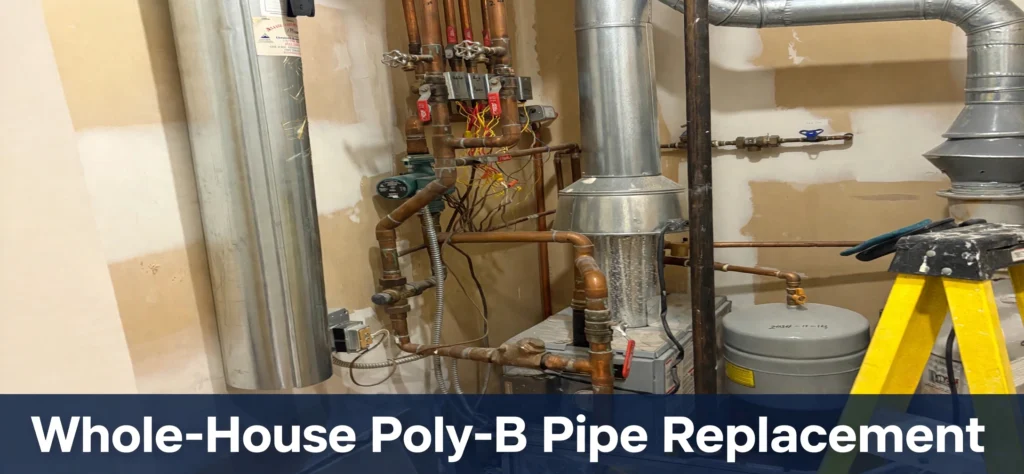
What Poly-B is
Poly-B — polybutylene — is a grey plastic pipe that was widely installed in BC homes built from the late 1970s through the 1990s. You can usually identify it by the colour and by the stamp on the pipe itself, often reading PB2110. At the time it was a modern choice: cheaper and faster to install than copper, flexible, and easy to run through a house.
It is still in thousands of homes across the Lower Mainland. Most of it has not failed. But it has a reputation that follows it, and that reputation is what homeowners run into — not usually a burst pipe, but a question on a form, a note on an inspection, a condition on a renewal.
What insurers flag
The first place most homeowners meet Poly-B is the insurance renewal. Many insurers ask whether the home has Poly-B, and the answer affects the conversation. Some will still insure the home. Some will ask for a repipe plan or a timeline. Some will charge more, or set conditions. The specifics vary a lot from one insurer to another, and from one policy to another — there is no single rule that covers every home, and anyone who tells you otherwise is guessing.
What is consistent is that insurers treat it as a known risk factor. That is the practical meaning of the reputation: it is not that every Poly-B pipe will fail, but that the industry has decided the material carries more risk than the alternatives, and it prices and underwrites accordingly. If you have Poly-B and your renewal is coming up, the useful step is to call your insurer or your broker before the renewal date and ask what they need — a timeline, an inspection, a repipe quote — rather than finding out from a letter after the fact.
A repipe quote is often the thing that moves the conversation forward. It turns an open-ended concern into a plan with a date and a cost, and insurers respond better to a plan than to a shrug.
What buyers flag
The second place Poly-B shows up is a sale. A home inspection will note Poly-B pipe when it is found, and a buyer will ask about it. That is not a deal-breaker on its own — plenty of homes with Poly-B sell every year — but it becomes a negotiating point. A buyer may ask for a price reduction, a repipe credit, or for the repipe to be done before closing. How much weight it carries depends on the market, the rest of the house, and how the seller handles it.
The sellers who do best are the ones who deal with it before listing. A repipe done ahead of time removes the question entirely, and the listing can say so. A repipe quote in hand, with a date, is the next best thing — it shows the buyer the problem is understood and priced. The sellers who do worst are the ones who are surprised by it in the inspection and have no answer ready.
If you are thinking of selling in the next year or two and you know the house has Poly-B, getting the repipe conversation started early is one of the highest-return things you can do. It is not the most expensive job in a pre-sale list, and it removes one of the most common reasons a buyer hesitates or a deal drags.
What a repipe actually involves
A full repipe replaces the Poly-B with new pipe — in our work, usually PEX — run through the same routes the old pipe took. The crews who do this every week have it down to a routine: the water is off for a period, sections of wall are opened where the pipe runs, the new pipe goes in, and the walls are closed up again. It is disruptive for a few days, and it is not a small job, but it is a known job with a known scope.
The timing question is the one people ask most. There are three moments when a repipe makes the most sense: before you list the house, when your insurer asks for a plan, or when you are already renovating and the walls are open anyway. Doing it during a renovation is often the cheapest moment, because the walls are already open and the crew is already there. Doing it before a listing is the moment that pays back most directly. Doing it because an insurer asked is the moment that removes a deadline.
One thing worth saying plainly: a repipe is not an emergency in most homes. Poly-B does not have a expiry date stamped on it, and many homes live with it for years without an incident. The reason to replace it is not panic. It is that the insurance and resale consequences arrive on someone else’s schedule — a renewal date, a buyer’s inspection — and it is better to be ahead of them than behind.
The takeaway
Poly-B is a material with a reputation, and the reputation is what you will deal with: an insurer’s question, a buyer’s inspection note, a condition on a renewal. The pipe itself may be fine. The paperwork around it is where the cost shows up.
If your home has it, find out what your insurer needs, get a repipe quote so you have a plan with a date and a cost, and think about timing — before a listing, during a renovation, or when the insurer asks. That is the whole job. It is not urgent, but it is worth doing on your own schedule rather than someone else’s.